
Online exams more credible than physical ones – e-Learning Management Consultant

0

An e-Learning Management Consultant, Dr Josephine Larbi-Apau, has asserted that online exams have more credibility than the normal hard copy exams taken in classrooms.
In an interview with Rev. Dr. Kwabena Opuni Frimpong on ‘What is Next’, Dr Larbi-Apau revealed that there are various mechanisms in place that makes it impossible for students taking an online exam to cheat.

“If you’re a student, you have to log in using your credentials (your username and password) but again you can go beyond that by using imaging. As you sit behind the computer the examination questions have been built in such a way that you have a camera built into the examination question (it’s a software) that will capture the image of the student on the question paper so as the student is writing his picture is on the question paper…When the student decides to leave and comes back it will capture it again,” he posited.

These mechanisms, Dr Larbi-Apau noted, makes it impossible for a student to get someone else to take the exams for him or her.

She also added that the questions of some online exams are randomized so if students in one examination hall decide to ask their colleagues for answers, they will end up getting it wrong as the numbering of their questions will be different.

“We have a way of setting up the questions. Let’s assume that you have a multiple-choice question. The multiple-choice questions are organized randomly in such a way that if we have 100 questions, your question 1 will be by question 10, your question 5 will be my question 8 so even if I talk to you in the exams room by asking you what is the answer for question 1 and you say ‘D’ that answer could be for question 10 so we randomize the questions and randomize the answers too… so there’s no way the students can cheat,” she said.

Even though there are no invigilators present for online exams, Dr Larbi-Apau stated that a clock attached to the questions is set for the duration of the paper it starts reading when the student starts answering the questions.
“It is time-based so when you start answering the questions, there’s a clock so it sets the clock, so if it one hour it starts ticking as soon as you hit start… and so the time that you’ll be wasting in talking it’s not going to wait for you.”

Other mechanisms in place that prevents students from cheating during online exams from the classroom, include blocking all other sites on computers students will be using so they can’t surf the internet for help.

Dr Larbi-Apau added that cameras can be set up in classrooms to take pictures of students in an exam hall from time to time to keep them in check.

After some level of resistance, students of some tertiary institutions in the country are set to begin online exams next week.

This is due to the closure of schools across the country as part of measures to curb the spread of the Coronavirus pandemic.

Source: www.ghanaweb.com
NDC Participates In EC Pilot Exercise

0

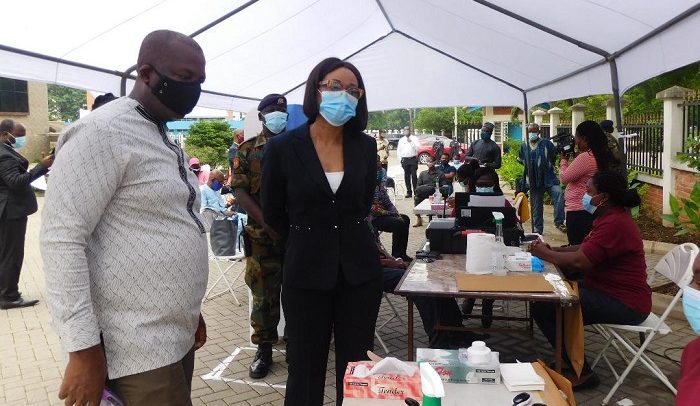
Jean Mensa (right)

Officials of the National Democratic Congress (NDC), led by its National Director for Information Technology (IT), Osei Kwame Griffiths, yesterday observed and participated in the Electoral Commission’s national piloting of its new biometric voter registration kits and the operation of the new software.

The NDC has been opposing the compilation of new a voters’ register and wants the EC to use the old voters’ register for the general elections in December.

The PNC, whose executives are divided over the register, also sent representatives to the premises of Ridge Church in Accra, where the national pilot registration took place, led by its national organizer, Desmond Twumasi Ntow.

The ruling New Patriotic Party (NPP) also sent representatives, led by former National Chairman, Peter Mac Manu, while the presidential candidate for the Liberal Party of Ghana (LPG), Percival Kofi Akpaloo, was also present to participate in the event.

Officials of the EC, led by Chairperson Jean Mensa, were also present to monitor and observe the process which will culminate in the scheduled nationwide new voter registration exercise scheduled to start on June 30 and end on August 6, 2020 at 33,367 polling centres.

Mock Exercise

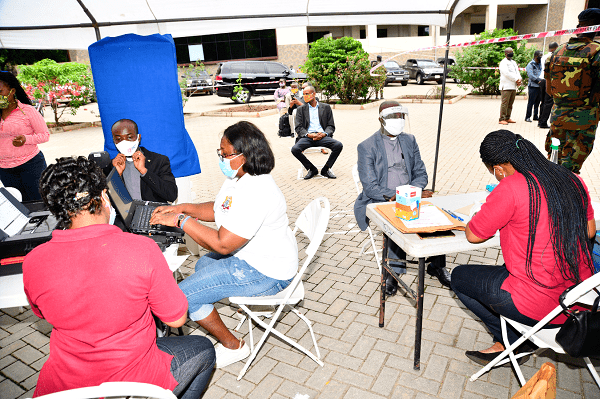
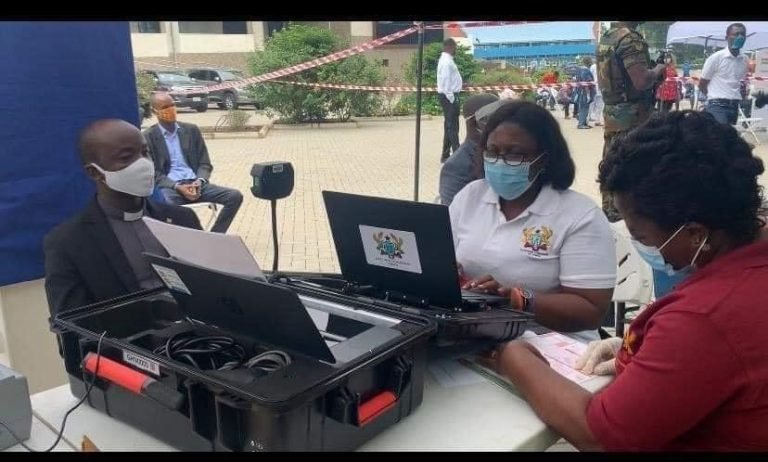
There were two registration centres, one meant for representatives of the political parties to go through the mock registration exercise and the other meant for selected members of civil society groups, including the clergy who underwent the registration using either the new NIA Ghana Card or a valid Ghanaian passport, which were the two permissible ID cards for the registration.

Before one enters the premises, there are Veronica buckets, bars of soap and tissue papers placed at the entry point with an EC official who will ensure that any person coming to register washes his or her hand before joining the queue, with social distancing protocol also being strictly observed.

Briefing journalists at the pilot registration centre, the Director in charge of Electoral Services at the Electoral Commission, Dr. Serebour Quaicoe, said that piloting at the regional levels took place on May 2 and May 3 to allow regional party representatives know the process better.

According to him, the EC’s national registration exercise will go on as scheduled beginning from June 30 with strict observation of Covid-19 health protocols during the whole process.

He said apart from the Ghana Card and a valid Ghanaian passport which will be accepted to prove one’s Ghanaian nationality, prospective applicants who do not have any of them could be vouched for by two registered Ghanaians.

According to him, a registered person can vouch for 10 people to prove their Ghanaian nationality to enable him or her to register.

Dr. Quaicoe explained that averagely the EC expects 100 people to be registered in a day at a polling centre, but if the process goes on very fast, a maximum of 250 people could be registered at a polling centre.

He expressed the hope that all the political parties would cooperate with the EC to ensure a successful registration exercise.

Mr. Mac Manu said the process so far has been smooth.

He, however, said that it will be very important for the EC to constantly educate the public on information that will have to be captured on the primary form or Form 1A.

He said if the EC educates members of the public on the necessary information needed to be captured on Form 1A, it will help reduce the processing time for every registration.

Mr. Twumasi Ntow told DAILY GUIDE that his party has serious concerns over health safety of individuals who will congregate at a polling centre to register, stressing that if a person has COVID-19, how is he or she going to be treated at the centre.

He also said that the time the registration will take place will not allow transfer of votes and special voting to be effected, which will be problematic for conduct of fair elections.

Mr. Griffiths said the NDC also has concerns but will address the press later on those concerns.

EC pilots BVRs ahead of June 30 registration exercise

0

The Electoral Commission (EC) on Thursday, June 18, piloted the new Biometric Voter Registration (BVR) kits it had procured for the mass registration of voters for the December 7, 2020 general election, with an assurance that no eligible Ghanaian will be disenfranchised.

The Director of Elections at the Commission, Dr Serebour Quarcoo, who gave the assurance, said minor challenges associated with the BVR kits had been identified and that they would be fixed to guarantee a smooth registration exercise.

As at about 8:30 a.m. yesterday, officials of the EC had set up the Accra Ridge Church in readiness for the pilot exercise.

And in compliance with the coronavirus disease (COVID-19) safety protocols, chairs were arranged at least two metres apart.

Some officials of the EC also positioned themselves at various entry points to the venue to ensure that patrons washed their hands and used hand sanitisers before they were allowed into demarcated areas.

They also ensured that everyone on the church premises wore a nose mask.

Patrons

The Chairperson of the EC, Mrs Jean Mensa, was at the centre to monitor the exercise. Some political actors, the clergy and civil society organisations (CSOs) also participated in the exercise.

Key among them were the Campaign Manager of the New Patriotic Party (NPP) for the 2020 elections, Mr Peter Mac Manu; the Director of Information Technology (IT) of the National Democratic Congress (NDC), Mr Osei Kwame Griffiths; the Founder of the Liberal Party of Ghana (LPG), Mr Kofi Akpaloo; the General Secretary of the All People’s Congress (APC), Mr Mordecai Thiombiano; and an Independent candidate in the 2016 election, Mr Joseph Osei Yeboah.

A former General Secretary of the Christian Council of Ghana (CCG) and Chief Executive Officer (CEO) of Alliance for Christian Advocacy Africa (ACAA), Rev. Dr Kwabena Opuni-Frimpong, also participated in the exercise.

Mixed reactions

After going through the processes, Mr Mac Manu said he was confident that the EC would compile a credible register.

For his part, Mr Griffiths said the exercise was fraught with challenges that gave the indication that the EC would not be able to register all eligible voters and compile a credible register before the December 7 elections.

He said an analysis of the pilot registration at the regional and national levels showed that the 38 days set aside by the EC for the mass registration exercise would lead to congestion that could disenfranchise many Ghanaians.

Process

Dr Quarcoo said it would take a prospective voter 15 minutes to complete registration and receive a card; however, a person could spend more time if he delayed in providing the needed information to registration officers.

He said the commission had also deepened engagements with the National COVID-19 Response Team and the Ghana Health Service (GHS) to ensure that protocols and safety measures were put in place at registration centres.

EC conducts pilot registration exercise

0

The Electoral Commission, on Thursday, June 18, 2020, organized a pilot exercise at the Ridge Church premises in Accra.

The one-day exercise was meant to afford stakeholders the opportunity to familiarize themselves with the new biometric kits as well as the safety protocols rolled out by the Commission, among others.

The EC says it wishes to deal with issues emanating from the exercise before the commencement of the actual exercise which begins on June 30, 2020 and ends on August 6, 2020.

The process involved the checking of temperature and joining the two-metre marked queue as well as the observation of the safety protocols announced by to Ghana Health Service and the Ministry of Health.

The biometric details of applicants, including fingerprints, pictures and facial details were captured before the cards were finally given to each applicant.

Present at the demonstration were political party representatives, some members of Civil Society Organizations and the clergy as well as some members of the general public.

Source: rainbowradioonline.com

EC Gives Its Stakeholders A Feel Of The New Registration Centre

0

The Electoral Commission Thursday organised a demonstration session for its stakeholders on how the new Biometric Voter Registration kits (BVR) kits operate.

The Commission also gave an insight into how the anti-COVID-19 pandemic protocols would be observed at the registration centres on from Tuesday, June 30, when the registration for a Voters’ Roll commences.

The stakeholders include the representatives of the National Democratic Congress, Liberal Party of Ghana, New Patriotic Party, JOY, People Action Party, National Media Commission, the Institute for Democratic Governance (IDEG).

Dr Serebour Quarcoe, the Director of Elections at the Commission, also took the representatives through the health protocol processes they should expect at the centres

They involve the washing of hands, checking of temperature and joining the two-metre distance marked queues.

He explained that a person would first need to show either a passport or the Ghana Card as proof of identity and provide details to enable the officer to fill the form A.

After that table, the individual would proceed to the next table, where the person’s biometrics, including fingerprints, picture and facial details, would be taken before proceeding to the last stage where the card is issued.

He also took them through the process of vouching for a person who would not have any of the two identification cards, and the online process for pregnant women and persons above 60 years.

The Reverend Dr Kwabena Opuni-Frimpong, Chief Executive Officer of the Alliance for Christian Advocacy Africa, asked political parties to make sustainable peace and development their guiding principles.

“Opposing factions will not go into a competition and behave like there nothing at stake. Every election season we hear allegations and counter allegations,” he stated.

“These allegations don’t mean that they don’t love their nation; but they all mean well.

“Nobody wants Ghana to crush. All stakeholders want the best for the country. The people in-charge must, therefore, listen to the issues and take steps to correct them. It will also help improve and deepen our democracy. We all want the country to progress”

Commenting on the event, he expressed satisfaction at the processes, saying that because he had one of the identification cards the process was smooth.

He said the Commission had taken the COVID-19 safety protocols such as the washing of hands, checking of temperature, use of hand sanitizer and social distancing very serious.

However, he said, “There was a little bit of technical hitch, but I think these are machines I cannot speak to that.”

Mr Peter Mac Manu, the 2020 Election Campaign Manager of the ruling NPP, expressed satisfaction, especially at the safety protocols and the speed of registration process, saying it was encouraging.


“Overall, I spent about seven minutes. At the first table, where my data was taken, it took just three minutes to complete it and at the second table, I spent about four minutes. The EC has done very well and this shows the real registration will be successful,” he said.

Mr Osei Kwame Griffiths, the Director of IT for the NDC, however, said the average registration time would not be enough to register all Ghanaians at the stipulated time.

Source: GNA

The idea of seeing Telcos as cash cows in Ghana has to change – Ken Ashigbey

0

CEO of Chamber of Telecommunication, Mr Kenneth Ashgbey has posited that in order for telecommunication companies to effectively contribute to the growth of e-learning in the country, there is the need to ensure the operating environment is cost friendly for the companies.

Speaking on ‘What Next’ with Rev Dr Kwabena Opuni-Frimpong on GTV, Mr Ashigbey said in order for students across the country to have access to internet service regardless of their geographical location, various parties including government and the Telcos must ensure the development of infrastructure within the sector. This he adds, has become hard within the operational policies that the companies have had to operate in Ghana.


“We’ve gotten to a point where as a country the way we see this industry as a cash cow has to change. We need to provide services and infrastructure such that everybody can get access to it (the internet). But that will not happen when typically, in Ghana you sell a 2×10 spectrum at $60 million whilst Tanzania with even a bigger market is selling at $10 million,” he noted.

Answering a question on how two Telco operators in Ghana with operations in Rwanda are able to give free internet access to university students and staff in Rwanda but are unable to replicate same in Ghana, Mr Ashigbey said such a pursuit requires policy and regulatory directions intended to create a cost friendly environment for operators in order to happen.

“The question you would want to ask is how much Telcos in Rwanda purchase spectrum compared to here, what is the cost of operation? Currently as we speak, in Ghana about 40% of every cedi that you pay to the Telcos go back to government in the form of levies and taxes,” he answered.

Suggesting some solutions to the existing situation, Mr Ashigbey said on its part, government needs to ensure that the cost of operating in the industry is as low as possible and also provide incentives whilst guarantying demand for the services of Telcos in the places they operate.

Coronavirus: Don’t ignore friends, loved ones because of social distancing – Rev Dr Kwabena Opuni-Frimpong

As the world is learning to adjust to social distancing to prevent people from contracting coronavirus which has been declared a global pandemic, Chief Executive Officer of Alliance for Christian Advocacy Africa, Reverend Dr Kwabena Opuni-Frimpong has urged all not to allow the current situation create a barrier between themselves, their families and friends.
Acknowledging the fact that the social distancing order from government was to help curb the virus which is fast spreading, he was of the view that the habit should also not lead to social isolation.

In a press release copied to GhanaWeb, he posited that “social distancing comes with the weakness of fear, frustration, loneliness, selfishness, denial of bereavement, mental and emotional instability etc. But we can as well demonstrate strength”.

He stressed that “this is the moment for us to practice our common humanity like kindness, compassion, patience, love, sense of belonging, demonstration of faith, support systems etc. Let us find our better selves and demonstrate our better selves in the midst of the new normal. We must open our hands to the pains of others as we accept the instructions to practice social distancing”.

Source: www.ghana

Stigmatisation can destroy, let’s avoid it – Kwabena Opuni-Frimpong

The Chief Executive Officer of the Alliance for Christian Advocacy Africa (ACAA), Rev Dr Kwabena Opuni-Frimpong, has cautioned friends and families to desist from stigmatizing against people who have recovered from COVID-19.
According to the CEO, there have been reports of stigmatization against people who have recovered from the COVID-19 in the media. He stressed that, these people should rather be testimonies and success stories for the Church and the Nation. In fact, ‘their success stories can minimise the fear and anxiety in the country if we welcome them into our societies. We are all at risk and therefore we must avoid stigmatisation,’ he emphasised.
Rev Dr Kwabena Opuni-Frimpong has also noted that, if we keep stigmatising against people who have recovered from the disease, others who are with similar symptoms may refuse to report to health facilities for treatment and this will result in the spread of the disease.

The CEO has therefore called on the Church and the general public to refrain from stigmatising against people who have recovered from the disease. There is therefore an urgent call on Societies, Churches, Work Places, Families etc to welcome people who have recovered from the disease, listen to their stories and allow them to have impact on those who are going through similar challenges. ‘People who have gone through this pandemic are the people we need at the moment to inspire hope in others,’ he said.

Source: Communication Unit
Alliance for Christian Advocacy Africa Share

While you celebrate frontline health workers, don’t forget the media, they are equally at risk

0

Former General Secretary of the Christian Council of Ghana, Rev Dr. Opuni Frimpong has urged the Government and Ghanaians to give equal attention to the media as they are giving to frontline health workers in the fight against COVID-19.
Speaking exclusively to ABC News, the Presbyterian Minister argued that just as some health workers are putting their lives in danger by dealing directly with COVID-19 patients, journalists are also endangering their lives by going across the country to look for COVID-19 related information; through interviews to furnish Ghanaians with the needed information and education, and this, he said, can equally lead to the contraction of the disease.
“Elsewhere, media people who are sent out for correct information have contracted the virus and some are already dead and gone so while we celebrate our medical people or the frontline medical people for the excellent work they are doing, there are others, especially the media who are at risk because if you are talking about saliva and all that and they are sending microphones and things to people, going to communities and listening to them, they are already exposed to the threat,” he stated.
There has been a raging controversy among health groups in the country after President Akufo-Addo announced a 50% allowance for ‘frontline health workers’ for the next three months.
The controversy has been over who indeed qualifies to be called a ‘frontline’ health worker.

While the health workers controversy is still running, another sector, the media, is also demanding to be noticed as ‘frontline’ workers due to the nature of their work.
One group which is pushing this agenda is the Media Foundation for West Africa (MFWA) which is arguing that categorisation of ‘frontline workers’ should be broadened to include the media.
Wading into this growing discussion, Dr. Opuni Frimpong also posited that the discussion must begin on including the media in the category of frontline workers.
However, Dr. Opuni explained that media owners should discuss the allowances for their workers, especially those who are sent on assignments or better still, government can reserve a package for journalists no matter how small.
“But who should answer the question as to what should be given to the media, we must continue that conversation, maybe the various media houses must do it if it’s not coming from the government or government must have a package for the media, no matter how small. Our media being at the frontline of the fight should not be ignored that they not making a significant impact in the fight.”
“In fact, some media persons in the US have died out of coronavirus already and we don’t know if even some of our media persons already have it or not because they have not been tested and the kind of work they do, they are also equally at risk.”
“So that proposal that any insurance should cover media, I’m all out for it, maybe who should do it is another problem. Whether the various media houses should do it for their members or government,” he told ABC News.
Dr. Opuni Frimpong commended the media for the work they are doing during the outbreak of the COVID-19 infection.

“The media has done very well…Some of the media platforms, they update you, not only even in Ghana, ABC your platform, for instance, you hear some of your team members updating us with things happening outside Ghana with correct, genuine, well-researched information and that media role they have played, whether they are part of the front liners and they should be given allowances, is another question but on the whole, Ghanaian media has done very well in terms of giving Ghanaian media the correct information,” he added.

Source: ABCNewsgh.com

Coronavirus: Embrace survivors rather than stigmatizing

0

Executive Director of the Alliance for Christian Advocacy Africa, Rev Dr. Kwabena Opuni Frimpong has raised concerns on the need to create a welcoming atmosphere for recovered COVID-19 patients rather than neglecting and stigmatization.
He explained that the negative attitude towards victims are a major hindrance to the fight against the spread of the pandemic.

Rev Opuni made the call when addressing the general public via his outfit’s YouTube channel to support the response against COVID-19.

“When a COVID-19 patient feels stigmatized, he or she may not open up for management and treatment, and by so doing spreads the virus gradually within communities, which could cause havoc for us as a nation,” he noted.

The Executive Director, therefore, advised the citizenry to stop the stigma to help build self-esteem in victims and facilitate the fight against the virus.

“Let us stop the stigma and accept victims in our societies so as to motivate them to educate the rest of us on the importance of staying safe from the virus, and I think that will be a great step in fighting the disease”.
So far, ninety-seven cases of the new coronavirus have been recorded as the country’s tally rise to 5,735, the Ghana Health Service reports.

The number of recoveries have also risen by 294 to 1,754 while one more death sends the tally of fatalities to 29.

Savannah, Bono East and Ahafo regions also remain coronavirus-free. Share

Friends

0
Apostle Eric Nyamekye

Political parties are the biggest problem facing voter registration – Dr. Opuni-Frimpong

0

The Chief Executive Officer (CE0) of the Alliance for Christian Advocacy Africa (ACAA), Reverend Dr. Kwabena Opuni-Frimpong has urged all Ghanaians to avoid being manipulated by political parties to cheat the voting system through multiple registrations.

According to Dr. Opuni-Frimpong, people who indulge in the unscrupulous act of registering multiple times, as well as those who register though they’re below 18, among other electoral vices, are influenced by the major political parties and that should be stopped.

“There are individuals who will register two, three, or four times in different locations and it is not like somebody wakes up in the morning and say, ‘I am going to do multiple voter registration’. It is being done by the various political parties, members of parliament. They bus people and deliberately urge them to do double and multiple registration,” he said.

He noted that the country has always been faced with the problem of the validity of the voters register during elections although the constitution has clearly defined the requirements for registration.

“Per the laws of our land, who qualifies to vote is very clear, in terms of age, in terms of nationality, in terms of residence and settlement. We should abide by what the laws of the land,” he said.

Dr. Opuni-Frimpong advised that for the country’s voters register to be credible, leaders in the country should inculcate a strong sense of integrity.

“We need credible voters register, and it is human beings that help with a credible voters register. We cannot get it as long as we decide to manipulate the system … credibility of leadership, fairness, and truthfulness is what we need to create a credible voters register,” he stated.

He also called on all Ghanaians to be candid as they register to vote in the 2020 general elections.

“I call every Ghanaian, let us go and register, but let us be sincere in the process,” he concluded.Source: www.ghanaweb.com

Coronavirus: Don’t ignore friends, loved ones because of social distancing – Rev Dr Kwabena Opuni-Frimpong

0

As the world is learning to adjust to social distancing to prevent people from contracting coronavirus which has been declared a global pandemic, Chief Executive Officer of Alliance for Christian Advocacy Africa, Reverend Dr Kwabena Opuni-Frimpong has urged all not to allow the current situation create a barrier between themselves, their families and friends.
Acknowledging the fact that the social distancing order from government was to help curb the virus which is fast spreading, he was of the view that the habit should also not lead to social isolation.

In a press release copied to GhanaWeb, he posited that “social distancing comes with the weakness of fear, frustration, loneliness, selfishness, denial of bereavement, mental and emotional instability etc. But we can as well demonstrate strength”.

He stressed that “this is the moment for us to practice our common humanity like kindness, compassion, patience, love, sense of belonging, demonstration of faith, support systems etc. Let us find our better selves and demonstrate our better selves in the midst of the new normal. We must open our hands to the pains of others as we accept the instructions to practice social distancing”.

Source: www.ghanaweb.com